Kosher Wigs...
Some married Jewish women cover their hair when out of their
house. When they do this, they can use a scarf like Muslims
do. But, since sometime in the 19th Century, an accepted
alternative has been to use a wig.
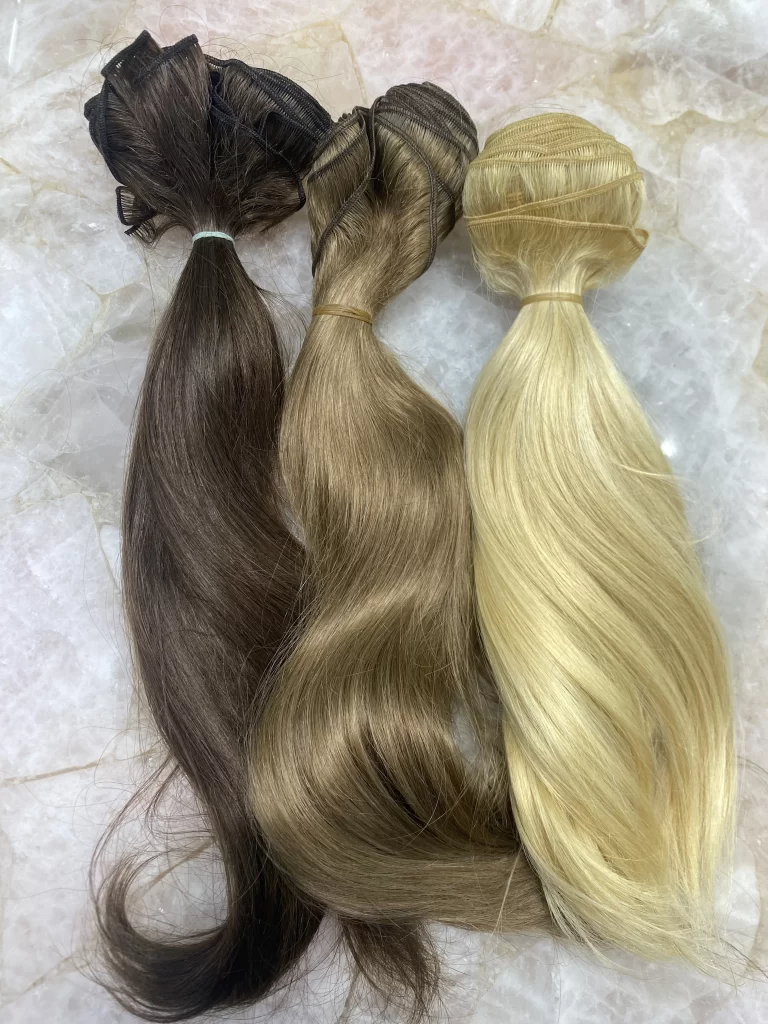
Well, wigs come in several qualities. There are synthetics, and then there are human hair wigs. The human hair wigs are generally thought to be (in quality from highest to lowest) European hair, Indian hair, Korean Hair. Supposedly, this has to do with texture and so forth.
So many middle class Jewish women have wigs made from hair "harvested" in India.
The question is, "How is this harvesting done?" This never used to be an issue, people thought that hair was hair. But it seems that a conservative Rabbi from England went to India and took some notes, and there arose a serious question.
As it turns out, much of the hair is harvested in a particular temple ceremony. Indian women, who may have never cut their hair since birth, go to a particular temple, and there they have their heads shaved as a way of showing piety. The hair is collected, and then sold by the temple to foreign buyers, for use in the wig trade.
Now, like almost everything that has to do with anything kosher, it comes down to something whacky.
See, if the hair is an offering to some Hindu god, then, well, those Hindus are polytheistic idolaters, and the hair is an offering. Once something is an offering to an idol, it can't be used by a Jew. Even if it is not eaten.
So, if the hair is the offering, then a Jew may not wear a wig made with even one hair from that source. But if the offering is the cutting of the hair and the subsequent bald head, then the hair is an unavoidable byproduct, and if it was never offered, it may be worn.
There is a group of conservative rabbis who are deciding this now. Once they come to a decision, they will then decide how many angels can dance on the head of a pin.
There is a deeper question. The reason that a Jewish woman covers her hair is to make herself more modest. She is only supposed to be immodest in private with her husband. If she wears a wig, and the wig makes her look better, is that being modest? Wigs were, at first, upper class only, with middle and lower class Jewish women wearing headscarves. When it became common for middle class women to wear wigs, the issue became one of concern. However, for a rabbi to say it was a bad thing, he would be saying that these upper class Jews were sinners, and, of course, that this mostly Jewish industry (wigmaking) was a bad thing.
Would you trust a Rabbi whose wife owned a wig store to make a ruling on this matter?
Perhaps the most amusing issue is that in some places, women are wearing obviously synthetic, cheap wigs as a way of showing their piety. In some congregations, it has become a serious issue and people are looking askance at those who wear human hair wigs, even when the wigs are all European (and therefore not suspect).
Well, wigs come in several qualities. There are synthetics, and then there are human hair wigs. The human hair wigs are generally thought to be (in quality from highest to lowest) European hair, Indian hair, Korean Hair. Supposedly, this has to do with texture and so forth.
So many middle class Jewish women have wigs made from hair "harvested" in India.
The question is, "How is this harvesting done?" This never used to be an issue, people thought that hair was hair. But it seems that a conservative Rabbi from England went to India and took some notes, and there arose a serious question.
As it turns out, much of the hair is harvested in a particular temple ceremony. Indian women, who may have never cut their hair since birth, go to a particular temple, and there they have their heads shaved as a way of showing piety. The hair is collected, and then sold by the temple to foreign buyers, for use in the wig trade.
Now, like almost everything that has to do with anything kosher, it comes down to something whacky.
See, if the hair is an offering to some Hindu god, then, well, those Hindus are polytheistic idolaters, and the hair is an offering. Once something is an offering to an idol, it can't be used by a Jew. Even if it is not eaten.
So, if the hair is the offering, then a Jew may not wear a wig made with even one hair from that source. But if the offering is the cutting of the hair and the subsequent bald head, then the hair is an unavoidable byproduct, and if it was never offered, it may be worn.
There is a group of conservative rabbis who are deciding this now. Once they come to a decision, they will then decide how many angels can dance on the head of a pin.
There is a deeper question. The reason that a Jewish woman covers her hair is to make herself more modest. She is only supposed to be immodest in private with her husband. If she wears a wig, and the wig makes her look better, is that being modest? Wigs were, at first, upper class only, with middle and lower class Jewish women wearing headscarves. When it became common for middle class women to wear wigs, the issue became one of concern. However, for a rabbi to say it was a bad thing, he would be saying that these upper class Jews were sinners, and, of course, that this mostly Jewish industry (wigmaking) was a bad thing.
But his opinions have had little impact in the Lubavitch community, which
takes its cues from its own leaders. They decided that "based on Jewish
law, you don't have to get rid of the wigs," said Rabbi Joseph Korf of
Hollywood's Community Synagogue Chabad Lubavitch.
His wife, Elisheva Korf, owns Elisheva's Wigs and Hair Boutique in North
Miami Beach.
"A lot of companies have had to get rabbinical OK's," she said. "That
has caused the price of [approved] wigs to go up. Now I'm getting
certificates that their wigs are kosher."
Would you trust a Rabbi whose wife owned a wig store to make a ruling on this matter?
Perhaps the most amusing issue is that in some places, women are wearing obviously synthetic, cheap wigs as a way of showing their piety. In some congregations, it has become a serious issue and people are looking askance at those who wear human hair wigs, even when the wigs are all European (and therefore not suspect).